
Products
Custom Glass Optical Fiber and Specialty Drawn Structures
CHI draws glass optical fibers, rods, tubes, and custom cross-sections for applications that require unusual dimensions, glass combinations, numerical aperture, geometry, radiation response, color, or integration into a larger fused structure.
CHI draws glass optical fibers, rods, tubes, and custom cross-sections for applications that require unusual dimensions, glass combinations, numerical aperture, geometry, radiation response, color, or integration into a larger fused structure.
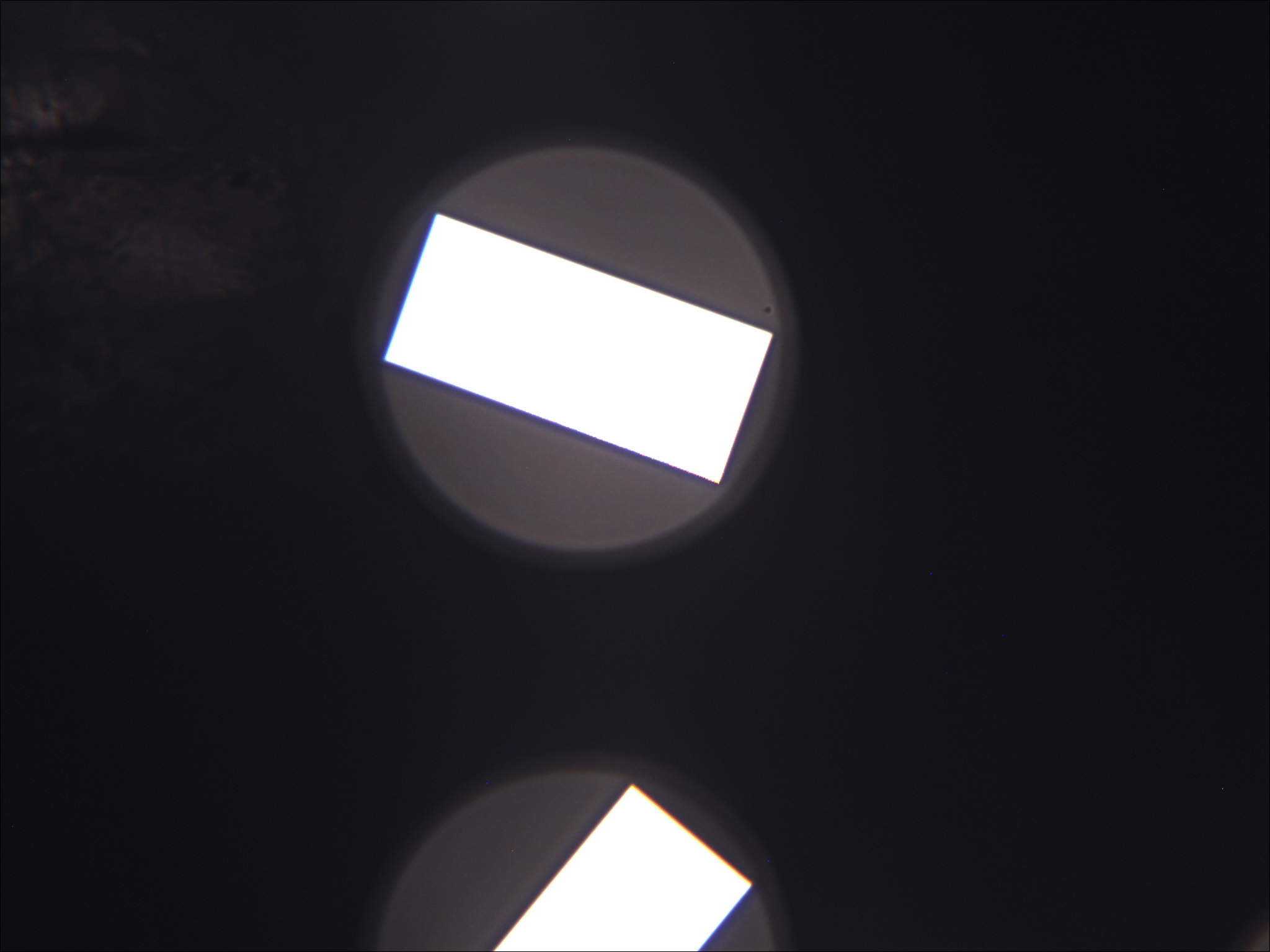
Circular Fiber with Rectangular Core
What Makes a Glass Fiber Optically Conductive?
A basic optical fiber contains a higher-index core surrounded by a lower-index cladding. Light entering within the fiber’s acceptance cone can be confined by total internal reflection at the core-cladding boundary and guided along the fiber. By selecting the glasses and dimensions, CHI can tailor numerical aperture, open area ratio, transmission behavior, and compatibility with later drawing or fusion steps.
Why Draw Fiber In-House?
CHI starts with glass preforms and performs the draw process internally. This allows process settings, dimensional reduction, glass pairings, and geometry to be coordinated with the final component rather than forcing the design around an available catalog fiber. It also provides a direct path from single-fiber development to multi-fiber and fused-fiber structures.
The Draw Process
A typical preform consists of a high-index glass rod inside a lower-index glass tube. The assembly is lowered into a controlled heat zone until the lower portion softens, then pulled from below faster than it is fed into the oven. Because the mass entering and leaving the heat zone must balance, the cross-sectional area decreases as the material lengthens. Coordinated feed and draw rates control the final size while the preform geometry is substantially retained.
Glass Selection
Glass selection is driven by refractive index, softening behavior, thermal expansion, chemical durability, transmission, radiation response, color, compatibility with adjacent glasses, and any later fusion or finishing process. CHI stocks a range of common and special-purpose glasses and can evaluate customer-provided or newly developed formulations when their physical properties are compatible with the draw process.
CHI cannot draw fused silica in-house because its softening temperature exceeds the operating range of our draw ovens. Applications requiring silica/quartz may still be possible using third party (or customer-provided) silica fibers or components.
When to Consider a Custom Fiber
Custom fiber is often the right path when catalog options fall short.
- The required numerical aperture or glass pair is unavailable in standard fiber.
- The fiber must have a square, hexagonal, or other noncircular cross-section.
- The project requires etchable, absorbing, radiation-resistant, colored, or scintillating glass.
- The fiber must be fused into a coherent array, image conduit, faceplate, remapping device, or specialty bundle.
- A standard polymer-coated telecom or illumination fiber is incompatible with the temperature, vacuum, radiation, geometry, or assembly process.
- The component must transition from an experimental configuration into repeatable production.
Representative Capabilities
| Variable | Available Design Direction |
|---|---|
| Fiber diameter | A preform several centimeters across can be drawn to a wide range of reduced diameters. Finished fibers can range from roughly 50 µm to several mm, with other sizes evaluated by design. |
| Cross-section | Circular is standard. Square, hexagonal, and more complex custom geometries may be created when the preform can be machined and the shape remains stable during drawing. |
| Numerical aperture | CHI’s glass inventory allows us to create combinations with NA’s that range from approximately 0.1 to 1.0, controlled by the difference between the refractive indices of the core and cladding glasses. |
| Glass families | Borosilicate, lead-oxide, soda-lime, radiation-resistant, etchable, colored, dark, scintillating, and other compatible formulations. |
| Absorbing glass | EMA may be applied around a fiber or incorporated into a multi-fiber structure to reduce stray-light propagation and cross-talk. |
| Product form | Single fiber, rod, capillary tube, multi-fiber, fused array, light guide, faceplate, image conduit, or subassembly. |
Information to Include With an Inquiry
- Wavelength range or radiation environment
- Desired fiber diameter and cross-section
- Numerical aperture or core/cladding refractive indices
- Core-to-clad ratio or open area ratio
- Glass restrictions and environmental exposures
- Required length, straightness, flexibility, end finish, coating, or packaging
- Whether the fiber will remain individual or be fused into a larger structure
- Prototype and production quantities
Related terms: fiber, glass drawing, numerical aperture, extra-mural absorption, multi-fiber, and optical conduction.
Frequently Asked Questions
Can CHI reproduce a customer’s existing fiber?
Possibly. A useful evaluation includes a drawing or sample, glass information, optical requirements, dimensional tolerances, and the reason a replacement or second source is needed.
How small can a glass fiber be drawn?
The practical minimum depends on glass, geometry, core/clad proportions, transmission requirements, handling, and whether the fiber will be used individually or inside a fused structure. Extremely small visible-light fibers may lose efficiency when the cladding becomes too thin to support effective optical confinement.
Can the fiber be bent?
Small glass fibers can be semi-flexible, while larger fibers and fused bundles become comparatively rigid. Larger structures can often be permanently formed to a controlled route rather than flexed repeatedly in service.
Can CHI provide optical coatings?
CHI does not perform coatings in-house, but can coordinate a range of optical coatings, including dichroic coatings, through long-term specialty suppliers when the substrate and application are suitable.
Discuss a custom fiber
Provide the wavelength, glass environment, geometry, diameter, NA, length, final assembly, and expected quantity - or describe the performance problem the fiber must solve.
Discuss a custom fiber requirement