
Products
Custom Glass Capillary Arrays and Microhole Plates
CHI manufactures precision structures containing large numbers of controlled, parallel holes. These glass capillary arrays - also called collimated hole structures - can be designed for collimation, filtration, fluid control, particle handling, optical discrimination, alignment, and other specialized functions.
A glass capillary array is a plate, disk, block, tube bundle, or custom-shaped structure containing many small channels. CHI can create the channels by chemically removing an etchable glass from a fused structure or by drawing and assembling glass tubes. The two methods produce different combinations of packing density, channel length, interior finish, geometry, and cost.
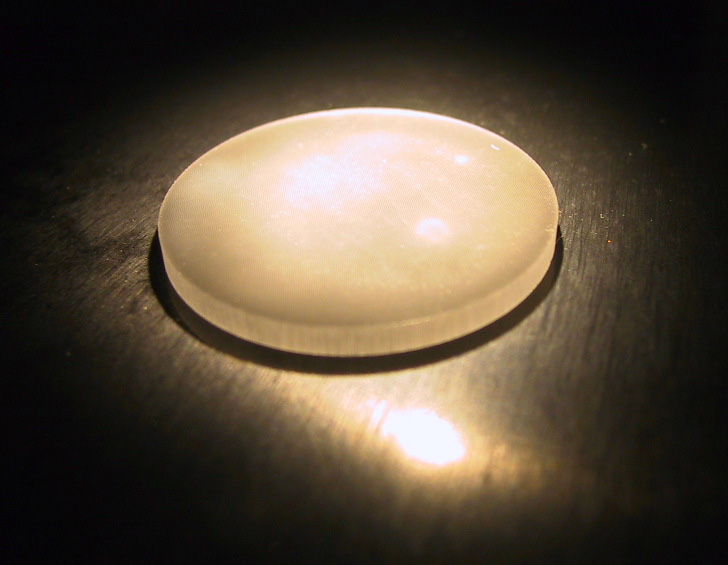
Ø25mm x 2mm thick Soda-lime Glass Capillary Plate with 100µm Holes
What Is a Glass Capillary Array?
A glass capillary array is a plate, disk, block, tube bundle, or custom-shaped structure containing many small channels. CHI can create the channels by chemically removing an etchable glass from a fused structure or by drawing and assembling glass tubes.
Representative Applications
Capillary arrays support a wide range of optical, fluidic, and mechanical functions.
- X-ray and radiation collimation filters
- Precision transparent sieves and particle filters
- Laminar-flow and calibrated-leak devices
- Microchambers for biotechnology and pharmaceutical research
- Gas chromatography columns and glass flow cells
- Optical filters for angular discrimination
- Membrane support structures
- Fiber and component alignment devices
What Controls the Design?
Hole size alone does not define a useful capillary array. The channel diameter, pitch, wall thickness, open area ratio, length-to-diameter ratio, interior surface, plate material, exterior dimensions, flatness, and edge condition interact. A change made to improve one characteristic can affect strength, flow, transmission, collimation angle, or manufacturability.
The Capillary Array Design Guide explains these relationships in more detail.
Etched or Drawn Construction?
Fused and Etched Arrays
- High packing density and strong channel-to-channel uniformity are achievable.
- Well suited to plates containing very large numbers of small, parallel holes.
- Thickness is limited by the ability of the etchant to reach and remove the soluble core glass.
- Collective curves or twists may be possible within process limits.
Drawn-Tube Structures
- Channels are fire-polished during drawing, producing very smooth interior surfaces.
- Not constrained by chemical etch depth, so much greater channel lengths are possible.
- Packing is generally less dense and uniform than in tightly fused, etched structures.
- Individual tubes and bundles can be formed into non-linear routes more readily.
Capability Overview
| Design Variable | Representative CHI Capability |
|---|---|
| Hole diameter | Common etched-array diameters include 5, 10, 25, 50, and 100 µm. Custom channels may range from submicron dimensions to several millimeters. |
| Hole geometry | Circular and hexagonal are common. Square and other symmetric, machineable cross-sections are also often possible. |
| Exterior size | 10–50 mm disks, squares, strips, and custom shapes are standard; larger structures up to >200 mm are also possible. |
| Thickness / length | Thickness ranges extend from approximately 75 µm to 350 mm for plates, with etched structures limited by a maximum length-to-diameter aspect ratio. Drawn capillaries can be much longer. |
| Open area ratio | Custom designs may range from below 1% to over 70%, depending on the method, channel geometry, wall thickness, and structural requirements. |
| Length-to-diameter ratio | Etched channels have a practical aspect-ratio limit of approximately 300:1. Drawn tubes are not limited by chemical etch access in the same way. |
| Materials | Lead-alkali silicate, borosilicate, and soda-lime glass are the most commonly used. Other compatible glasses may be available by custom review. |
Information to Include With an Inquiry
- Intended function and operating environment
- Preferred glass or relevant chemical, thermal, and radiation exposure
- Hole diameter, geometry, pitch, and acceptable variation
- Plate diameter or width and length; round, square, strip, or custom exterior
- Thickness or channel length
- Required open area ratio or minimum wall thickness
- Surface finish, coating, edge, mounting, and flatness requirements
- Prototype and production quantities
Learn more about glass drawing, the etching process, capillary diameters, interior surfaces, open area ratio, and length-to-diameter ratio in the design guide.
Configure a capillary quotation
Use the dropdowns to describe a reference configuration. Selections pre-fill a request for quotation for engineering review.
Configure a capillary quotation
Use the dropdowns to describe a reference configuration. We do not publish outdated price tables - selections pre-fill a request for quotation for engineering review.
Configuration summary
Plate size: 25 mm × 25 mm
Plate shape: Square
Capillary diameter: 25 µm
Capillary geometry: Hexagonal close pack
Process: Fused etched array
Quantity band: Prototype (1–5)
Indicative configurations for quotation only. Final pricing follows engineering review of drawings, tolerances, glass, and quantity.
Request quote with these specsFrequently Asked Questions
Can CHI make a capillary diameter that is not listed?
Often, yes. The published legacy sizes are common configurations, not the full design range. Custom feasibility depends on channel size, plate size, thickness, glass, packing, and tolerance requirements.
Are etched capillaries smoother than drawn tubes?
Both can have high-quality surfaces, but they are formed differently. Drawn tubes are fire-polished during drawing. Etched channels expose the polished interface that existed between cladding and soluble core glass.
Can the holes be curved or nonparallel?
Etched arrays are best suited to controlled collective geometry and are usually straight and parallel. Drawn tubes provide more freedom for nonparallel or nonlinear routing.
Does CHI publish standard capillary-plate prices?
Contact CHI for availability, current specifications, minimum order requirements, and pricing.
Discuss a capillary-array requirement
Send the desired channel size, plate dimensions, thickness, open area, glass environment, and quantity - or send the system requirement and let CHI help develop the component specification.
Request a capillary-array review