
Capabilities
Integrated Glass Drawing and Precision Optical Manufacturing
CHI combines in-house glass preform design, drawing, etching, stacking, fusion, grinding, polishing, shaping, and specialty finishing to manufacture custom fiber-optic and capillary components from initial concept through repeat production.
CHI combines in-house glass preform design, drawing, etching, stacking, fusion, grinding, polishing, shaping, and specialty finishing to manufacture custom fiber-optic and capillary components from initial concept through repeat production.
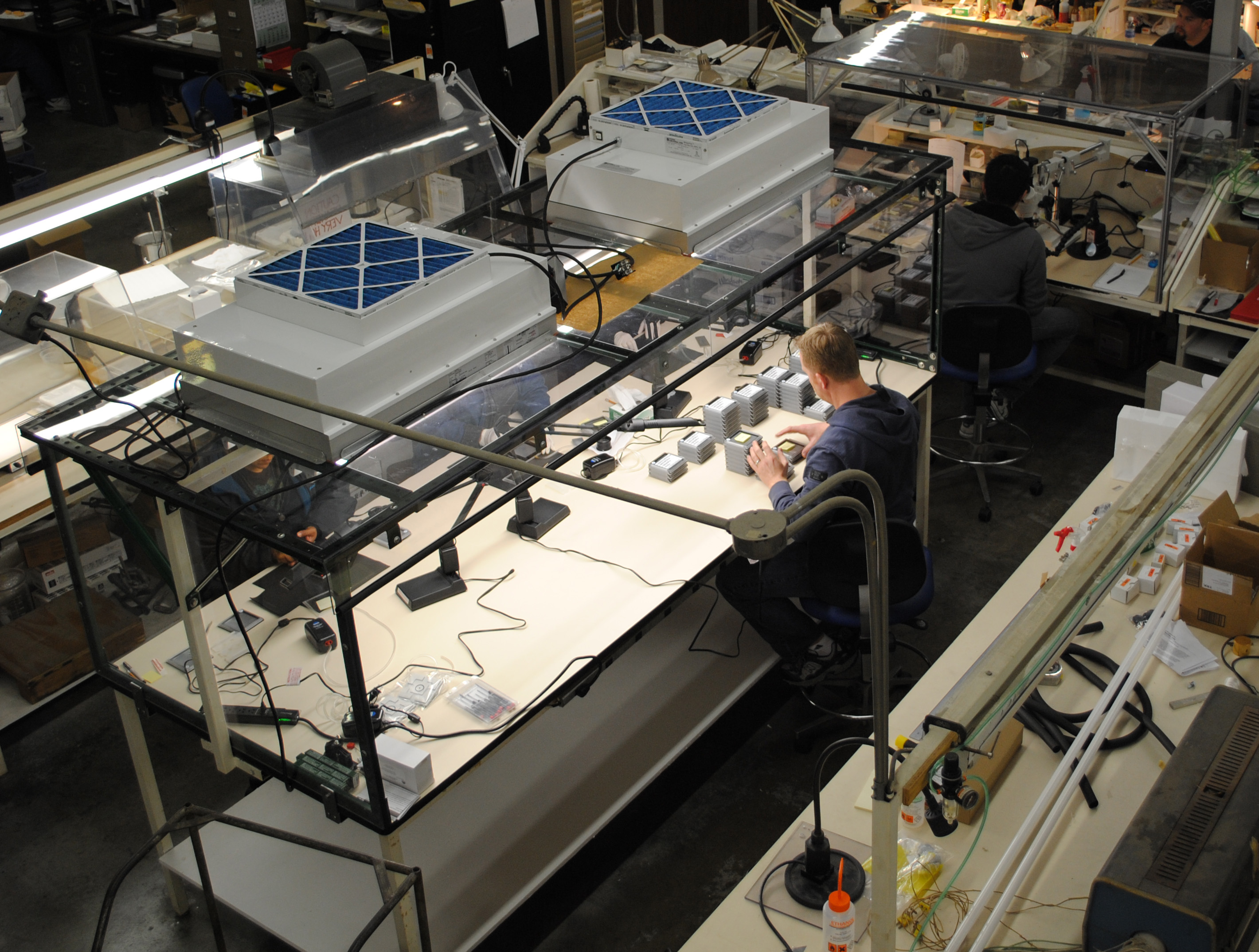
CHI Production Floor
Glass Preform and Drawing
Most CHI products begin with a glass assembly engineered at a larger, workable scale. A preform may contain a core rod and cladding tube, an etchable placeholder, multiple glass regions, absorbing glass, or a custom exterior geometry. The preform is heated and drawn to a smaller cross-section while its basic internal architecture is retained.
Drawing internally gives CHI direct control over reduction ratio, dimensions, glass combination, and the relationship between the intermediate fiber and the final fused or etched component. It also supports rapid iteration when a project requires a nonstandard geometry or material system.
Stacking and Fusion
Individual fibers, tubes, rods, or multi-fibers can be arranged into a controlled pack and fused through the draw process or under heat and pressure. Repeated stacking and drawing can create structures containing hundreds of thousands or millions of coherent channels. Final fusion produces blocks, boules, conduits, arrays, or other structures ready for slicing and finishing.
Chemical Etching
Etchable glass can be used as a temporary core or placeholder inside a more durable structure. After drawing, assembly, and fusion, the part is exposed to a controlled etching solution that removes the soluble glass and leaves open channels. Etchant chemistry, access, channel size, aspect ratio, and material compatibility determine the practical process limits.
Grinding, Polishing and Shaping
Finished optical and capillary components may require precision thickness, flatness, parallelism, surface finish, edge condition, or specialized geometry. CHI provides sophisticated grinding, polishing, and precision glass finishing for its own products and is happy to evaluate related custom glass-finishing work.
Coatings and Subassemblies
Working with long-term specialty suppliers, CHI can coordinate optical coatings on compatible fiber-optic substrates, including dichroic and reflective coatings. Projects may also include housings, connectors, bonding, alignment features, or more complete optical subassemblies when those elements are central to performance.
A Typical Custom-Manufacturing Path
Projects typically follow a staged path from requirements through production.
- Requirements review. Define function, critical performance, environment, dimensions, interfaces, quantities, and commercial constraints.
- Feasibility and concept. Select a glass system, preform architecture, process route, and first-pass tolerance strategy.
- Proposal and development scope. Document deliverables, nonrecurring engineering, schedule, assumptions, and acceptance criteria.
- Prototype fabrication. Build and inspect representative parts, then compare results with the intended application.
- Design refinement and qualification. Adjust geometry or process where needed and establish the production inspection approach.
- Repeat production. Manufacture against the approved configuration, drawing, specification, and quality requirements.
Quality Begins With a Measurable Specification
Custom glass components are most successful when the specification distinguishes critical-to-function characteristics from preferences. CHI works with customers to define measurable dimensions, optical parameters, surface requirements, allowable cosmetic conditions, test methods, sampling, and documentation appropriate to the application.
Frequently Asked Questions
Does CHI draw its own fiber?
Yes. In-house drawing is a central manufacturing capability and supports the custom glass combinations and geometries used throughout CHI’s product lines.
Can CHI manufacture a complete subassembly?
Potentially. CHI can evaluate housings, connectors, coatings, bonding, and integrated optical elements when a subassembly approach reduces risk or improves performance.
Can CHI work from a sample instead of a drawing?
A sample can be useful, but a successful reproduction effort also needs functional requirements, critical dimensions, material information, and acceptance criteria.
Are all coatings applied in-house?
No, CHI does not have in-house coating capabilities. Coatings are generally coordinated with qualified specialty suppliers. CHI manages substrate compatibility and project integration as appropriate.
Review manufacturability early
A short technical discussion before a drawing is frozen can prevent avoidable cost and open better options for glass, geometry, tolerance, and process route.
Review manufacturability with CHI